Harvest Brodiaea
Perennial herb
Common Names: Blue dicks, wild hyacinth
Species: Brodiaea coronaria
Family: Asparagaceae
Zone: 7-10
BEC Zones: CDF, CWH, PP
Height: 30 cm
Width: 15 cm
Conditions
Sun: Full sun.
Soil: Rocky clay, sandy loam, or Garry oak meadow soils.
Moisture: Dry to mesic.
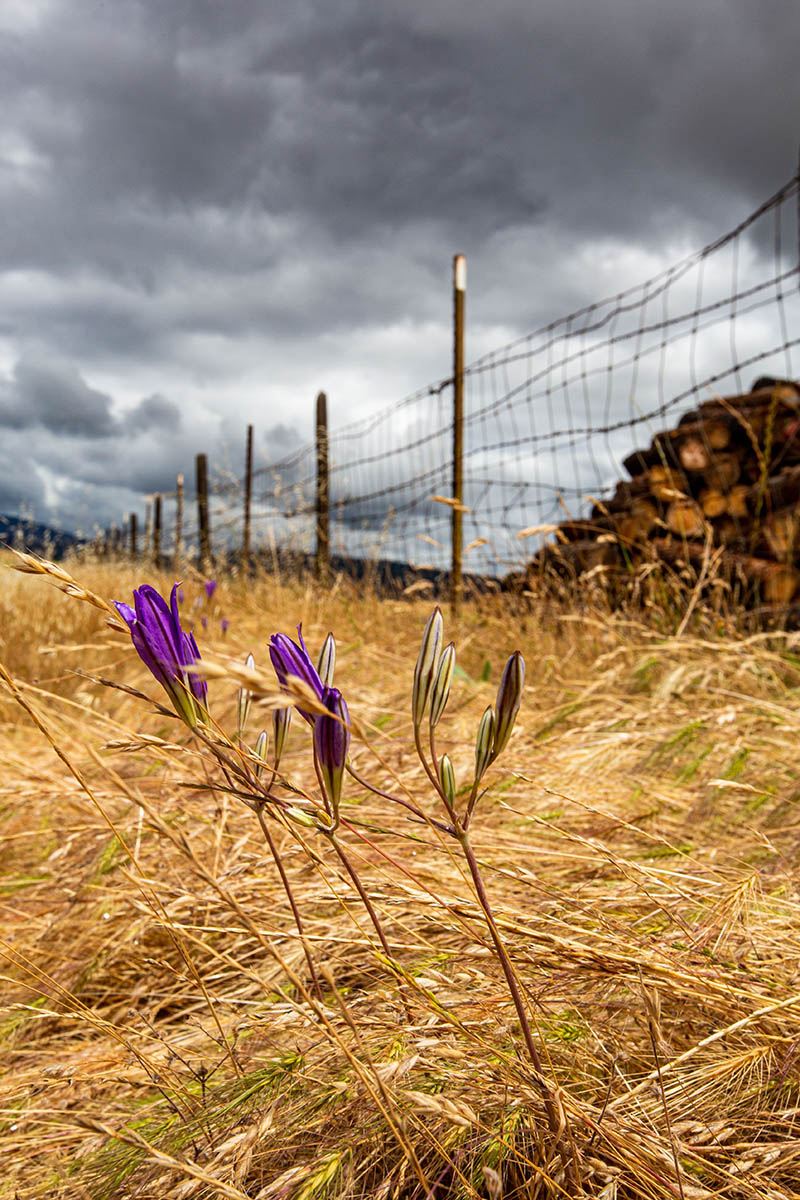
Exposure: Climax species in dry open, often gravelly, grassland sites (grassy meadows and slopes, rocky areas) at low elevations in the lowland and steppe zones. It ranges along the Pacific Coast from southwestern British Columbia down to Southern California, including the Sierra Nevada foothills, Coast Ranges, and Cascade Range; infrequent on SE Vancouver Island, the Gulf Islands, and adjacent mainland (isolated population at Spences Bridge); grows south to California.
Appearance
Shape & Stem: Flowering stems erect, stout, and smooth; typically 10-30 cm tall, sometimes reaching 40 cm.
Leaf: 1-3 basal leaves that wither before flowers appear. Leaves are smooth with entire margins, somewhat rounded (crescent-shaped in cross-section), sheathed at the base, linear in shape, and 2 mm wide and as long as the flower stem is tall. No stem leaves.
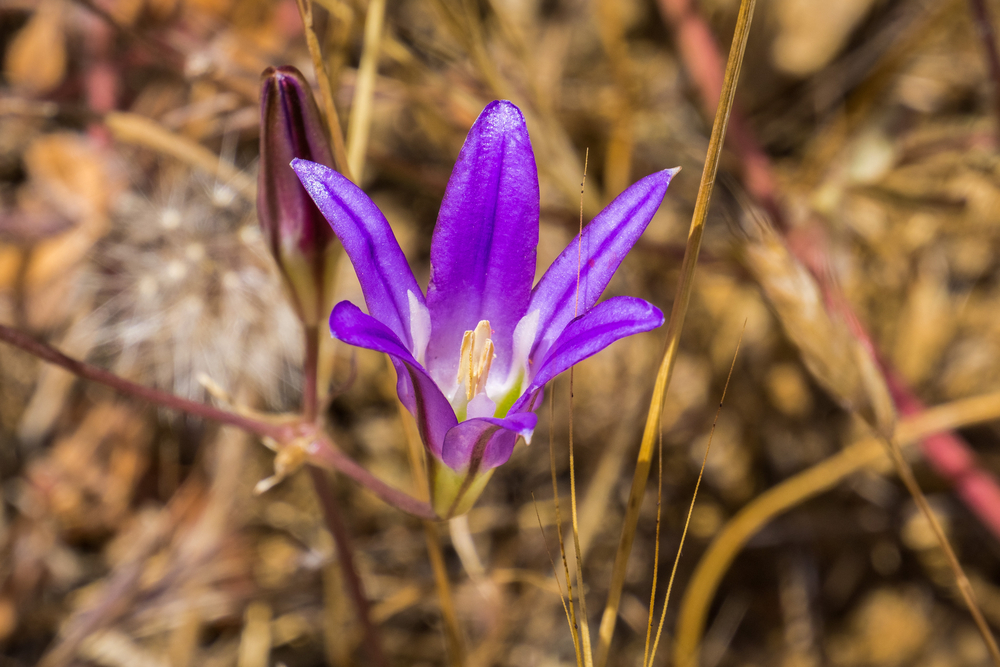
Flower: Violet-purple, vase-shaped, 2-4 cm long, unequally stalked; in loose umbels of 2-10 (usually 3-5) flowers, erect to spreading, above several bracts, the stalks stout.
Fruits: Egg-shaped capsules, unstalked, with black seeds.
Bloom: June-July.
More Information
Maintenance & Pruning: Lilies and Brodiaea are both in the Aparagaceae family however, Brodiaea blooms later in summer than most lilies. The soil must remain consistently moist in winter and spring, but bake completely dry in the summer to prevent the corms (bulbs) from rotting.
Landscape Use: Suitable as a rock garden plant. Attractive when used in rockeries and at the front of borders. Plant 15 cm apart for best results. Mix with nodding onion, common camas, satin flower, and native bunchgrasses.
Propagation: Collect ripe, dark-coloured capsules July – August, as they begin to split, and shake the seeds into a bag. Sow seeds in the fall in a gritty mixture of sand and loam. Seedlings take 3 to 4 years from germination to flowering.
Plant division: Lift dormant plants and separate the dark-brown, fibrous, bulb-like corm or cormels which are about 2 cm long. Air dry and store at 5ºC in slightly damp peat moss until spring. Shallow-plant the cormels in flats. New plants will form a corm and will bloom after one more year of growth.
Pests, Animals & Diseases: No serious pest or disease issues; generally a hardy, pest-free native bulb. However, to protect them and ensure healthy corms (bulbs) when harvesting, you must watch for a few specific threats, particularly in the damp coastal environments around Victoria, B.C. Narcissus Bulb Fly (Merodon equestris) is the most significant pest for Brodiaea. The adults lay eggs near the soil surface. The resulting plump, yellowish maggots tunnel directly into the corm, hollowing it out.
Actionable tip: When digging bulbs for harvest or division, discard any corms with soft bases, pitting, or holes.
Other information: This is the only Brodiaea in our range with leaves this narrow. Because the related B. hyacinthina is more difficult to harvest (bulbs grow deeper), Brodiaea was the one normally harvested by First Nations and settlers, alike. An alternative explanation for the common name is that Brodiaeas bloom later in summer than most lilies.
Sources:
Pojar and MacKinnnon, 1994. Plants of the Pacific Northwest Coast.
Garry Oak Ecosystems Recovery Team, “Propagation Guidelines for Harvest Brodiaea”. https://goert.ca/species/brodiaea-coronaria/
Electronic Atlas of the Flora of B.C.: Brodiaea coronaria. https://linnet.geog.ubc.ca/Atlas/Atlas.aspx?sciname=Brodiaea+coronaria
Leave a Reply