
Sea Thrift
Perennial taproot herb
Common Names: Sea-pink
Species: Armeria maritima
Family: Plumbaginaceae
Zone: 3-9
BEC Zones: CDF, CWH
Height: 5-45 cm
Width: 15-30 cm
Conditions
Sun: Full sun to partial shade.
Soil: Chalk, clay, loam, sand.
Moisture: Dry to average soil moisture.
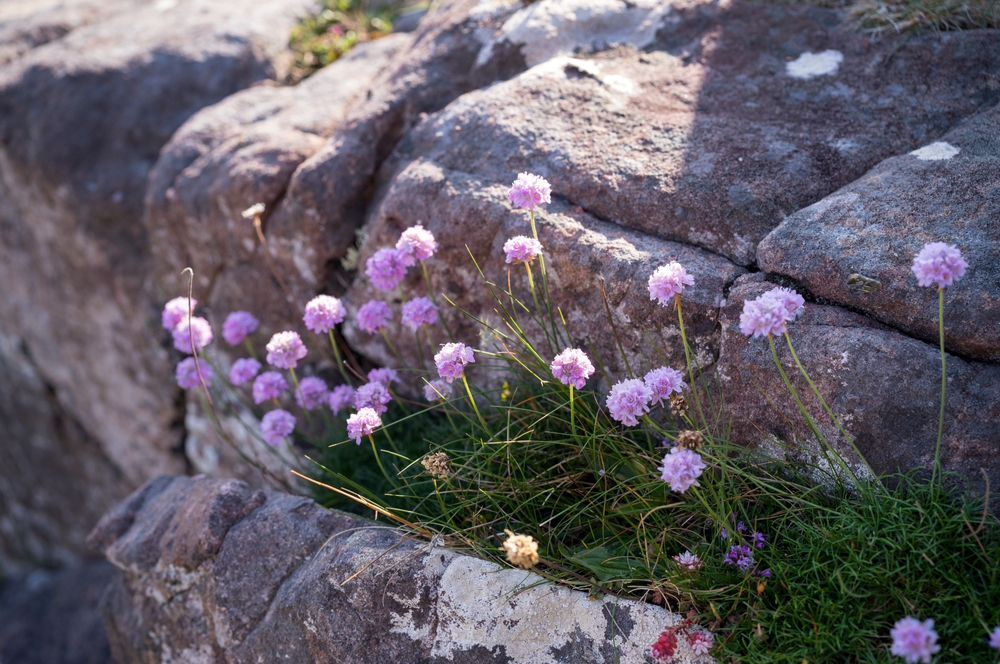
Exposure: Coastal beaches, bluffs, spits, scattered along the coastline. Sometimes found somewhat inland along riverbanks, grassy meadows, or woodland edges; at low elevations. Not particularly common in our region, but it occurs around the globe and on Arctic coasts and in Europe.
Appearance
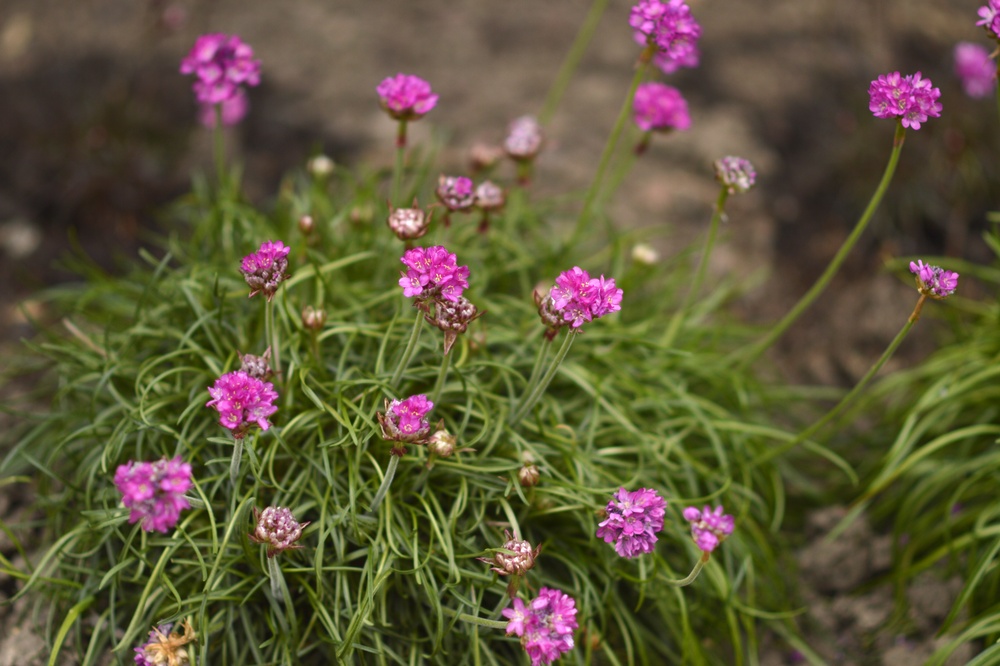
Shape & Stem: Perennial herb from taproot and branching stem-base; flowering stem is leafless.
Leaf: All basal, densely tufted, persistent, linear to narrowly lance-shaped, hairless to sparsely long-hairy, 5-10 cm long.
Flower: Pink to lavender, small (4-7 mm); sepals are ribbed with soft hairs, and fused at the base; petals are fused at the base, with 5 long, delicate, papery lobes. Flowers are short-stalked and numerous in head-like clusters with papery bracts; flowering stalks 1 to several per plant.
Fruits: Small, dry, nut-like bladders, often enclosed in the sepals, 1-chambered and 1-seeded.
Bloom: April-May.
More Information
Maintenance & Pruning: Clumps spread slowly and need dividing only when the centres become bare. Armeria needs the same kind of care as lavenders: good sun, great drainage, and not a lot of mulch. These plants actually do best with stone or gravel mulch instead of the usual wood mulch.
Landscape Use: Cut flowers, evergreen, showy. Fire-resistant; tolerant of drought, deer, salt, and rocky soil.
Propagation: Sea thrift is easily propagated, most commonly through division in early spring or early fall; this keeps plants healthy and prevents centers from dying out. It can also be grown from seeds collected from dried blooms, or via basal cuttings taken in summer.
Pests, Animals & Diseases: Root/crown Rot: Armeria usually aren’t victims of bugs or disease. By far, what gets them the fastest is crown rot from lousy drainage – caused by excessive moisture, poor drainage, or heavy, wet, clay soils. Powdery mildew: A white, powdery fungus that can appear on leaves if the plant has poor air circulation or is watered overhead.
Cultivars: Armeria maritima (Sea Thrift) cultivars are low-maintenance, drought-tolerant, and salt-resistant perennials popular for rock gardens and edging, featuring dense, grassy, evergreen mounds with globe-shaped flowers.
‘Alba’: Smaller than the species, this cultivar produces white flowers and grows about 5 inches high and wide.
‘Armada Rose’: Features bright rose-pink flowers on 6-8 inch stems. ‘Armada White’: A white-flowered cultivar in the Armada series.
‘Bloodstone’: Known for its vibrant, deep pink (almost red) flowers.
‘Cotton Tail’: A compact, 6 inch high cultivar with white flowers.
‘Rubrifolia’: (Red-leaved Sea Thrift): Features rose-colored flowers with dark green leaves that have burgundy coloring in spring and purple undersides, growing well in rocky soil.
‘Splendens’: A rugged selection with bright, rose-pink, globe-shaped blooms. It is highly salt-tolerant.
Comments: A ‘pink’ was an ornamental opening made in muslin to show the colour in Elizabethan dresses, which these flowers supposedly resembled. Alternatively, ‘pink’ may have derived from the Low German pingsten or Dutch pinkster for ‘Whitsuntide’ (the first 3 days of the week beginning with Pentecost Sunday) as pinks were also once called ‘Whitsuntide gilliflowers’ because they bloomed at that time of the year. ‘Thrift’ appears to be the passive participle of threave or thrive, meaning ’to press close together’ because the plants grow in dense tufts. However, others claim that it is so-called because it survives, or thrives, in poor, shallow soils. Armeria is Latin for a species of carnation.
Leave a Reply