Hairy Manzanita
Erect Evergreen Shrub
Common Names: Hairy manzanita
Species: Arctostaphylos columbiana
Family: Ericaceae
Zone: 6-9
BEC Zones: CWH, CDF, SWB
Height: up to 3 m
Width: 1-4 m
Conditions
Sun: Full sun to light shade.
Soil: Acidic soils with a pH of 4-6.5; poor soil nutrient regime. It prefers dry, well-drained, sandy and rocky soils.
Moisture: Dry to mesic.
Exposure: Dry, sunny spots at low elevations. Found most frequently on rocky slopes and outcrops, in disturbed clearings, and amid stands of Douglas fir. Found in late-seral to climax stages in dry, open coastal forests. It ranges from central and southeastern Vancouver Island south to coastal California.
Appearance
Shape & Stem: Erect or spreading, bushy to single-stemmed, evergreen shrub up to 3 m tall. Young twigs and leaves are very hairy, while older branches have rich reddish-brown bark that flakes and peels.
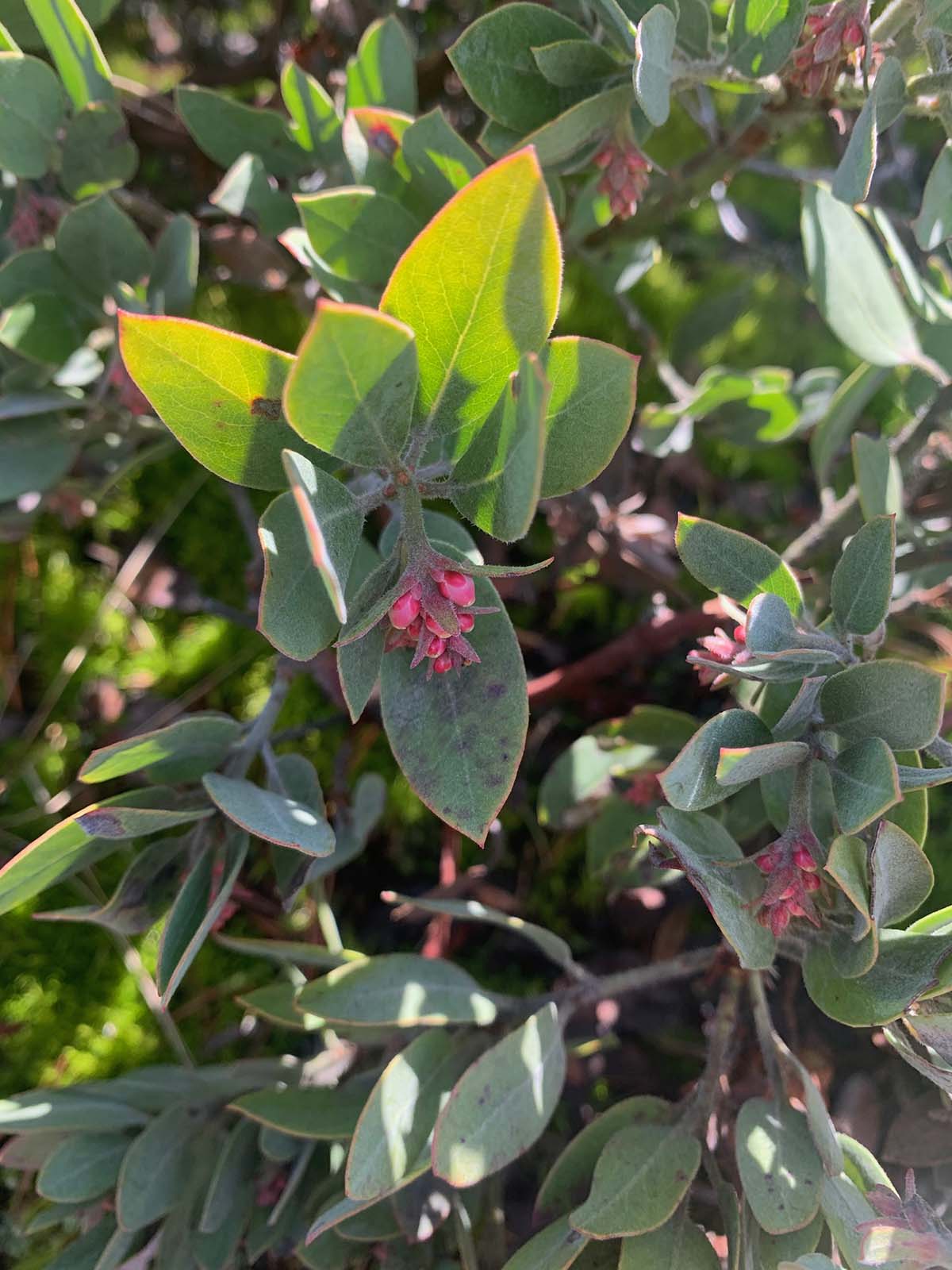
Leaf: Alternate, egg to lance-shaped, 2-5 cm long, hairy all over but more so underneath, with a greyish-green colour. Leaves grow only at the ends of the twigs. The young twigs and leaves are very hairy, hence the common name.
Flower: White to pinkish, urn-shaped, 6-7 mm long, in hairy clusters borne at the ends of branches. Flowers emit a delightful aroma.
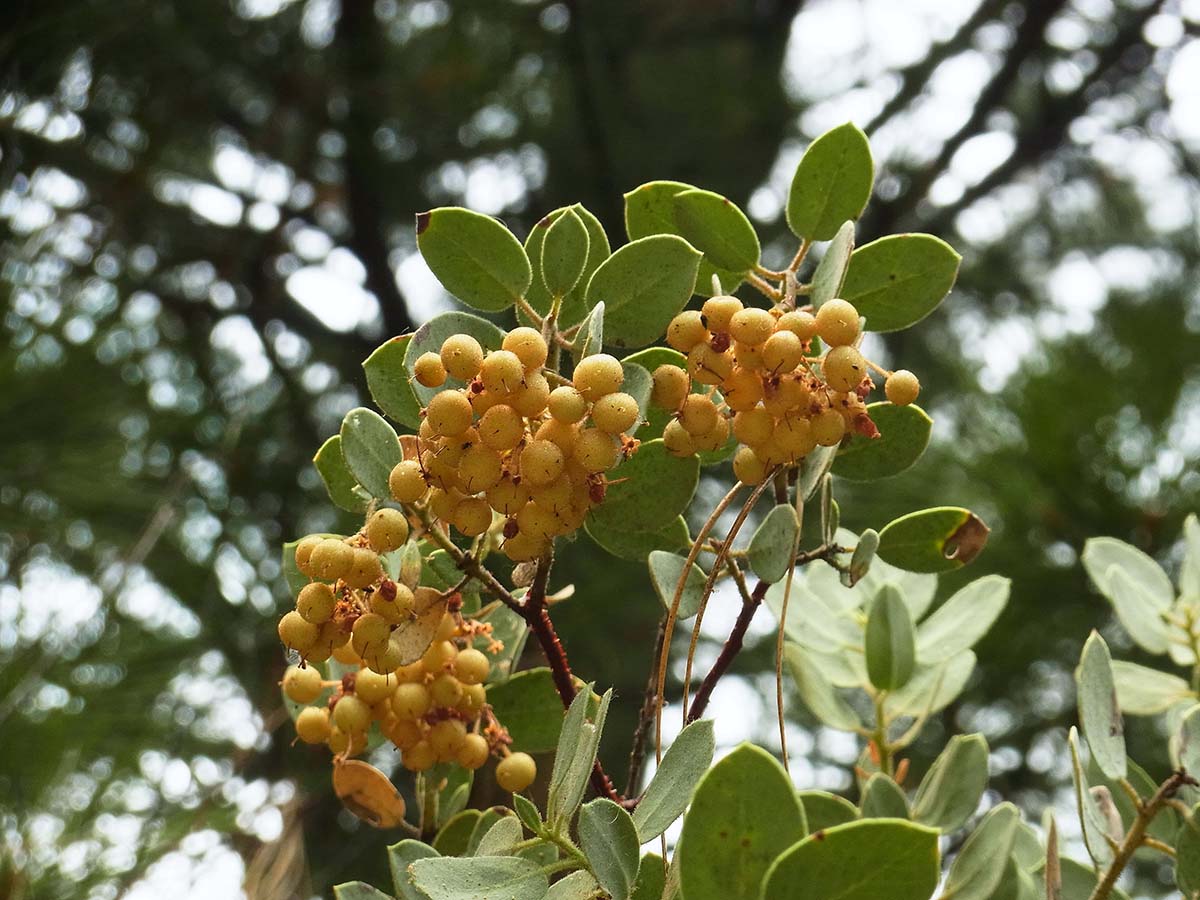
Fruits: Blackish-red (coffee-coloured) berries, 6-8 mm across, edible yet mealy. July-August.
Bloom: May-June.
More Information
Maintenance & Pruning: Prune sparingly, ideally after flowering in dry summer weather to avoid disease. Focus on removing dead wood, improving air circulation, and shaping for structure by making minimal cuts rather than shearing. Avoid cutting into old, leafless wood, as it will not resprout.
Landscape Use: Hairy manzanita makes a handsome display in sunny south or west-facing exposures, doing especially well on sandy, well-drained soils. It will take on a rounded form. The exquisite pattern of forked branching, the glossy, dark-brown bark, the charming cluster of white to pale-pink Pieris-like flowers, and the clusters of showy fruits are all features affording distinctive and pleasing character for the garden shrub.
Not easily available in local nurseries.
Has potential for land reclamation use on droughty, sunny sites.
The hybrid x media, with its smaller stature, may be more suitable for the urban garden. A word of warning: Hairy Manzanitas are allelopathic, meaning they give off waste substances through their root systems and decomposing leaves, which makes it difficult for many plants to grow near them, and can inhibit the growth of adjacent young plants.
Propagation: “Unfortunately, Arctostaphylos columbiana is a horticultural challenge not to be tried by the faint-of-heart home gardener, nor is it easily available at nurseries. With much trial and error, it has been propagated from hormone-treated cuttings started in a mixture of sand and peat. If you enjoy a challenge, achieve a distinguished horticultural accomplishment by growing one of these rare and beautiful native shrubs. It prefers a dry, sunny spot and slightly acid soil. Hairy manzanita is a good companion plant for the arbutus tree.” (Pettinger, 1996). Arbutus is also allelopathic.
Collect seed in August. Fruits may be hand-stripped or picked off the ground. Soak fruits in water and then macerate by hand or blender. Pulp can be removed by flotation, or the whole mixture may be dried and the seeds extracted by screening or a fanning mill (Meyer, 2002). Seeds retain viability for long periods in nature; thus stored seeds should retain viability for ten years or more. Seeds should be dried and stored at 2-4º C. Seed viability is less than 10%.
Embryo dormancy is not common. All seeds exhibit seed-coat dormancy, which is broken in nature by passing through the digestive system of an animal or by the effects of ground fires. Seeds should be scarified mechanically or by acid treatment (Meyer, 2002). The possible use of fire in dormancy treatment needs investigation, since it has been postulated that, while heat may erode the seed coat allowing water absorption, leachates from the burned vegetation may enhance germination.
Pests, Animals & Diseases: No significant pests or diseases. As soon as the fruit ripens it is devoured by grouse, jays, sparrows, chipmunks, and ground squirrels. Birds and small mammals shelter in the dense foliage during all seasons. In some areas browsing deer keep the shrubs low and compact (Pettinger, 1996).
Cultivars: Kinnikinnick (Artostaphylos uva-ursa) and hairy manzanita hybridize where their ranges overlap. The resulting low shrub, sometimes described as Arctostaphylos x media. A low growing, compact, red-barked form known as ‘Oregon Hybrid’ is offered in some nurseries.
While admiring Hairy manzanita, watch out for poison oak (Rhus diversiloba, also known as Toxicodendron diversilobum); its leaves have 3-5 irregularly lobed leaflets (somewhat like an oak leaf) that turn bright scarlet in autumn.
Manzanita is Spanish for ‘little apples’ alluding to the appearance of the small, brown fruits. Arctostaphylos is from the Greek arktos (‘bear’) and staphylos (‘a bunch of grapes’).
Comments: I first met this shrub on the top of Mount Erskine, above my home on Salt Spring Island. Initially, I thought it was an arbutus tree that had grown stunted and sideways due to occasional stormy and harsh conditions. The deep red peeling bark with the evergreen ovate and pointed leaves made me think they must be the same species or at least related. In the end, they are not but instead share a love of the rocky coastal habitat found in the Pacific Northwest.
Leave a Reply