

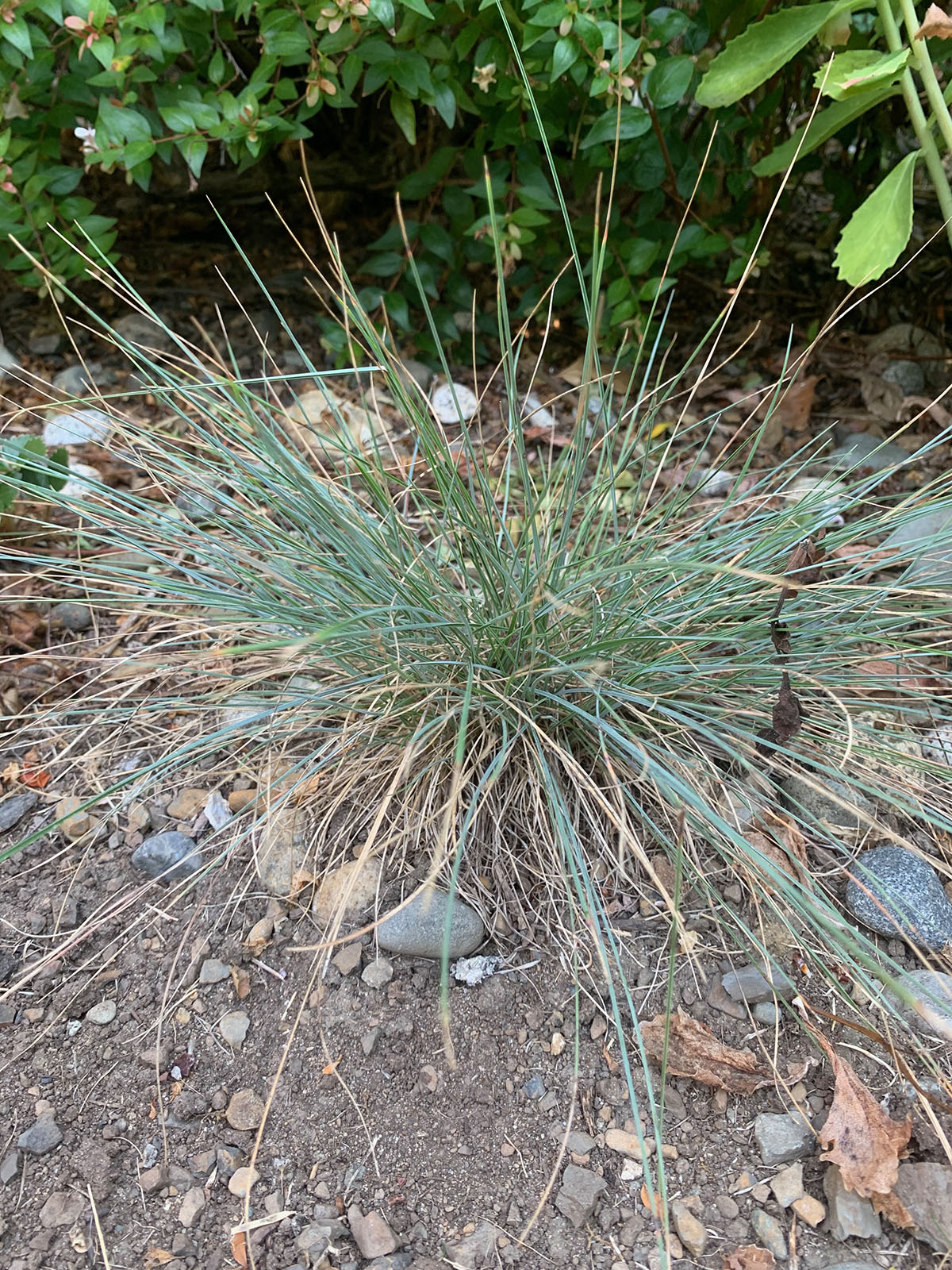
Roemer’s Fescue
Cool season perennial bunchgrass
Common Names: Roemer’s Fescue
Species: Festuca roemeri
Family: Poaceae
Zone: 8-9
BEC Zones: CDF, CWH
Height: 35-100 cm
Width: 30-60 cm
Conditions
Sun: Full sun, tolerant of some shade.
Soil: Well-drained, shallow, often rocky soils. Prefers moderately acidic to slightly alkaline, and fine- to medium textured mineral soils.
Moisture: Very drought-tolerant; not tolerant of wet clay, or sites subject to riparian inundation or vernal sogginess.
Exposure: A dominant plant of oak savannahs and grasslands west of the Cascades and the Sierras, from B.C. to Northern California. Grows in open forests and grasslands.
Appearance
Shape & Stem: A very attractive bunchgrass with compact, finely textured tufts that usually stand less than 30 cm tall but with inflorescences growing to 90 cm or more. It’s an evergreen, looking its finest in the cooler months when it sports lush blue-green foliage; stem colour ranges from light green to dark purple or red.
Leaf: Basal leaves are glaucous; silvery blue-green blades grow to 40 cm, and airy inflorescences grow to 90 cm or more.
Flower: Unremarkable; tan flowers on 1′ spikes
Fruits: Panicle (seed head) is open and 5-20 cm long.
Bloom: May-June.
More Information
Maintenance & Pruning: Seed heads can be removed in the fall, otherwise it requires little to no maintenance.
Landscape Use: Deer-resistant, drought-tolerant, and non-aggressive. Widely used in prairie and oak savannah restoration, as its robust root system provides effective erosion control. Ideal for meadow gardens, dry sunny areas, parking strips, and open areas in need of winter interest (e.g. a pollinator garden with dormant perennials). It is an excellent underplanting for drought-adapted shrubs, especially on slopes where it helps stabilize the bank. In a minimally- or non-irrigated garden, Roemer’s fescue will follow its natural cycle of going dormant in the summer; however, regular watering and good drainage can keep it lush all summer long. It can spread by seed, volunteering itself in new locations, which makes it perfect for wilder, rather than manicured, areas of the garden.
Propagation: Seeds germinate without treatment, however, germination is quicker and more uniform after 14 days of cold, moist stratification (chilling). There are approximately 500,000 seeds per lb with hulls intact. A seeding rate of 1 lb per acre results in about 12 seeds per sq. ft. Sown alone, recommended rates vary from 4-20 pure live seed (PLS) lbs per acre depending on goals. Fall seeding is generally preferred but not required. The rate of establishment from seed is moderately slow. Spring-sown plants do not flower until the second full growing season. This species is presumed to be well adapted to fire as a natural feature of prairie ecosystems. It may possess management requirements similar to Idaho fescue, such as deferred grazing every few years, but verification is needed. Maret and Wilson (2005) found that burning significantly increased seedling establishment in Roemer’s fescue.
Pests, Animals & Diseases: Larval host to Mardon skipper (Polites mardon), a rare Pacific Northwest butterfly; and a likely host plant for the woodland skipper butterfly (Ochlodes sylvanoides). Provides excellent cover and nesting habitat for arthropods. It is susceptible to stem and leaf rust which can severely weaken plants.
Cultivars: None
Comments: Found only west of the Cascades and northern Sierra Nevada Mountain Ranges. Occurs from Douglas County and northeast Jackson County, Oregon, north to British Columbia, and south along the Pacific coast to San Francisco.
Leave a Reply