

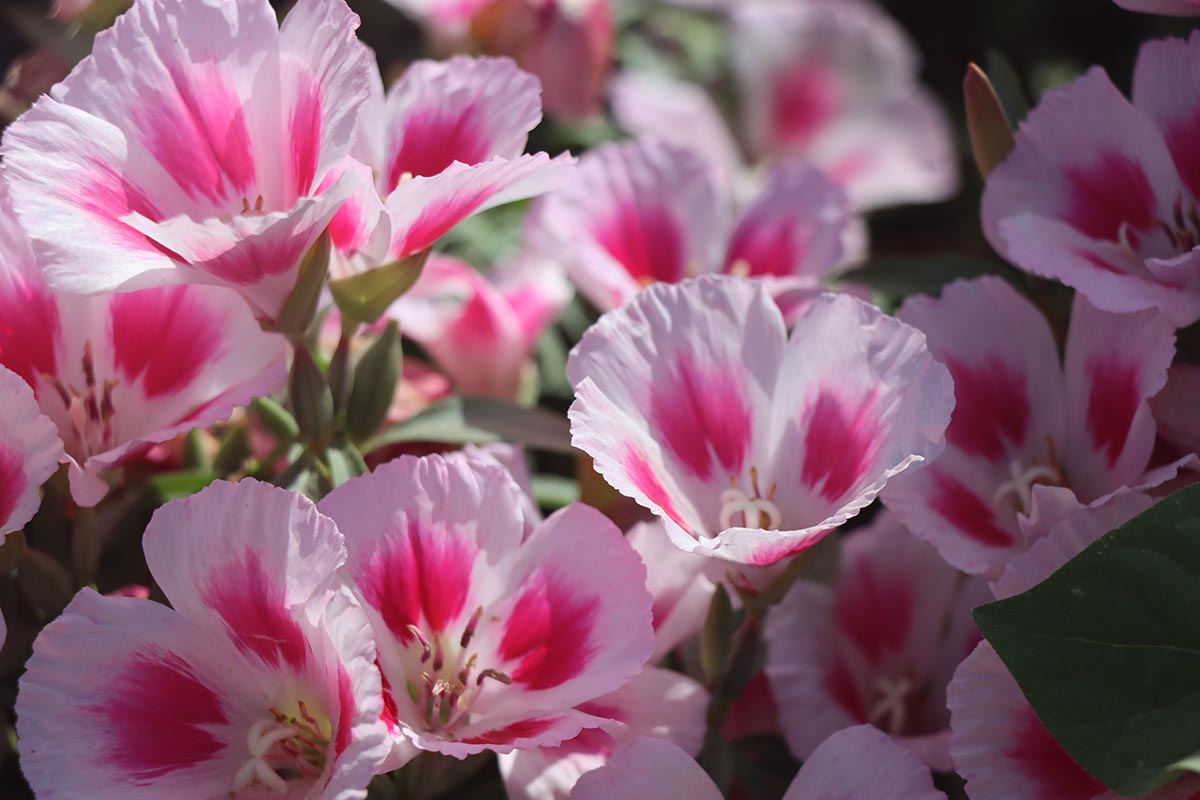

Farewell to Spring
Taprooted annual
Common Names: Farewell-to-Spring, Summer’s Darling, Herald-of-Spring, Atlas Flower, Red Ribbons, Fairy Fans
Species: Clarkia amoena
Family: ONAGRACEAE
Zone: 3-9
BEC Zones: Coastal Douglas Fir (CDF), Coastal Western Hemlock (CWH); Garry Oak ecosystems in southeast Vancouver Island and the surrounding Gulf Islands
Height: 10-100 cm
Width: 20-45 cm
Conditions
Sun: Full sun to light shade.
Soil: Well-drained; tolerates seaside conditions, alkaline soil, salt, sand and clay.
Moisture: Dry.
Exposure: Relatively dry, grassy open slopes and bluffs; forest edges at low elevations; also found in meadows, prairies, seaside bluffs, coastal scrub, roadsides, and spring wet areas. Scattered, locally common, more common in Washington and Oregon. This species’ native distribution ranges from southern British Columbia west of the Cascades, south to the coast of central California, and east into the Columbia River Gorge at elevations below 3000 ft; it also has been introduced in Quebec.
Appearance
Shape & Stem: Stems spreading to upright, simple to freely branched, leafy, 10-100 cm tall.
Leaf: Alternate, linear- to lance-shaped, smooth-edged, 2-7 cm long; upper leaves are more persistent and often folded.
Flower: Pink- to rose-purple with a dark-spotted centre, with more-or-less notched edges; showy and cup-shaped; 4 petals, 1-4 cm long. Stamens 8; few to several in loose, leafy-bracted clusters. The flowers are single or in open to dense inflorescences with buds held erect.
Fruits: Capsules pod-like, long (1-4.5 cm), narrow, straight to curved, 8-ribbed, 4-chambered. Seeds numerous, angled, not hairy; ripe in the fall. The green sepals that encase the unopened buds have the peculiar habit of bursting along one side and bending back in a single piece, as the flowers expand.
Bloom: May to July. There may be a second flush of blooms on new plants in the fall.
More Information
Maintenance & Pruning: This species is drought-tolerant and requires little maintenance once established. Farewell-to-Spring readily self-sows in suitable locations, so blooms should be deadheaded if volunteer seedlings are not desired in the following season.
Landscape Use: A beautiful addition to beds, borders, containers, dry banks, cottage gardens, rock gardens, and wildflower meadows. The flowers make excellent, long-lasting bouquets. The flowers bloom later than most other spring annuals.
As with all native annuals, this plant will spread by seed and form larger patches as long as the area isn’t mulched after the seed drops in late summer. The seeds are tiny and must remain near the soil surface where the fall rains coincide with their germination. Through fall and winter, the new leaves will form green carpets of small foliage (with a hint of pink that matches the flowers). They will bloom the following spring.
Propagation: Best propagated by direct-sowing seeds in fall or early spring (after last frost is okay too), as they dislike root disturbance.Seeds require no pre-treatment, should be surface-sown on well-drained soil in full sun, and need only a light covering (15 cm) of soil. Seed the bed at a rate of approximately 2 pounds per acre. Germination takes 7-14 days.
Seeds can also be sown in flats of potting soil indoors and planted out at a spacing of 15-30 cm after the last frost date in the spring, but plants will generally be sturdier if direct-seeded. Soils should not be over-fertilized or the plants will produce abundant, leggy foliage and few blooms.
Pests, Animals & Diseases: No serious pest or disease issues, although plants are susceptible to powdery mildew, verticillium wilt, stem rot, and leaf spot; as well as aphids, mites, and Japanese beetles.
Beneficial Insects: Flowers serve as a nectar source for European honey bees, as well as native bumble bees, mason bees, butterflies, and other beneficial insects. Farewell-to-Spring is often included in native wildflower mixes for bee and butterfly meadows or gardens.
Cultivars: Seeds are widely available from commercial sources. There are at least a dozen improved horticultural cultivars on the market that range in color from white to peach to deep magenta; and include dwarf varieties, and varieties with more leaves or highly dissected petals. Flowers of improved cultivars are often larger and more abundant than those of wild ecotypes. Their showy pink flowers are either open goblets or have ribbony petals.
There are five generally recognized subspecies of C. amoena, although intermediates among subspecies are common: Hunt’s clarkia (C. a. ssp. huntiana), Lindley’s clarkia (C. a. ssp. lindleyi), northwestern farewell-to-spring (C. a. ssp. caurina), Whitney’s clarkia (C. a. ssp. whitneyi), and farewell-to-spring (C. a. ssp. amoena).
Of Interest: The common name acknowledges this species’ habit of flowering in midsummer, as the grass dries and most other flowers are past. For this reason, Clarkia amoena is also called ‘summer’s darling’, or ‘herald-of-summer’ – much less melancholy names!. The species amoena means ‘charming’, which this plant is indeed. Clarkia is for Captain William Clark of the famous Lewis and Clark expeditions.
Leave a Reply