Pacific Flowering Dogwood
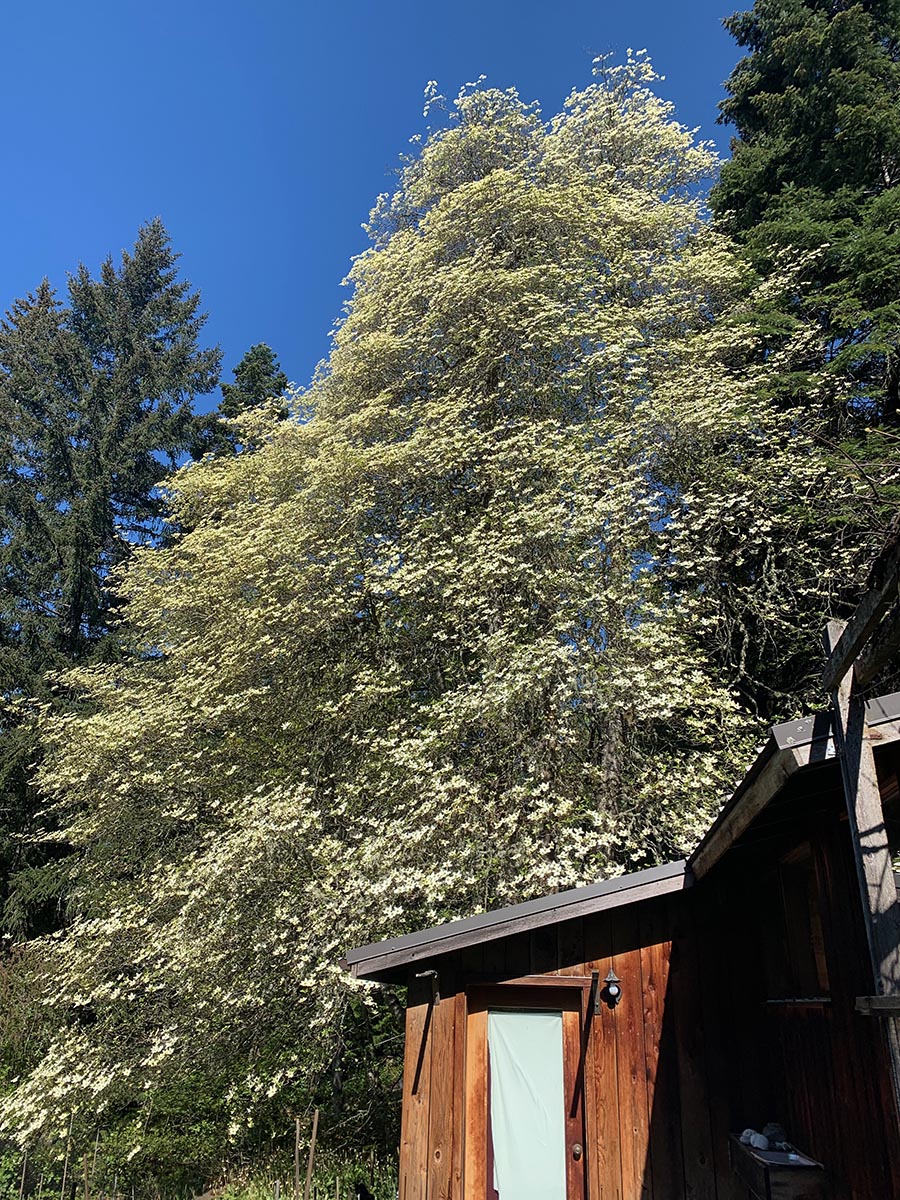
Deciduous multi-branched flowering tree
Common Names: Western flowering dogwood
Species: Cornus nuttallii
Family: Cornaceae
Zone: 7-9
BEC Zones: CDF, CWH
Height: up to 20 m
Width: 3-8 m
Conditions
Sun: Full sun to partial shade.
Soil: Rich, acidic, and well-drained; thrives in sandy, loamy, or heavy-clay soils.
Moisture: Requires consistent moisture, requiring a cool root run (the soil stays cool, moist, and protected from intense sun, even if the plant’s top growth is in full sun).
Exposure: Moist, well-drained sites at low elevations, often along streams or gullies in open to fairly dense, usually mixed, forest. Found along the Pacific Coast of North America from California to British Columbia. In British Columbia, it is found in the southwestern corner of the province, both on the mainland and Vancouver Island. It occurs on mesic, nitrogen-rich forest soils, and is a relatively common part of the shrub layer in mixed and coniferous forests in the region.
Appearance
Shape & Stem: Many-branched trees; smooth, blackish-brown bark that becomes finely ridged with age.
Leaf: Opposite, deciduous, oval, sharp-pointed at the tip and tapering towards the base, up to 10 cm long. Colour is deep-green above, greyish-green below, turning pinkish-red in the fall, with characteristic ‘dogwood veins’ that curve parallel to the leaf edge.
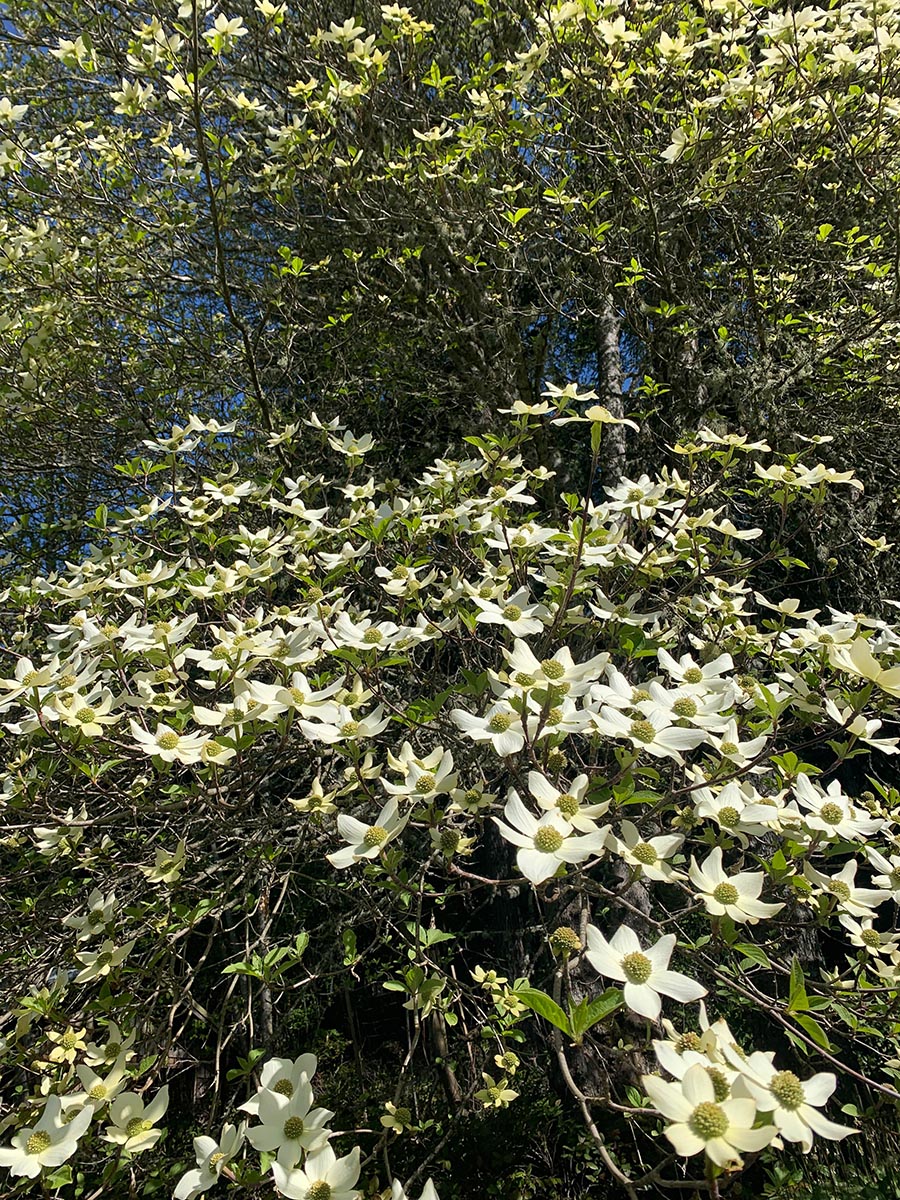
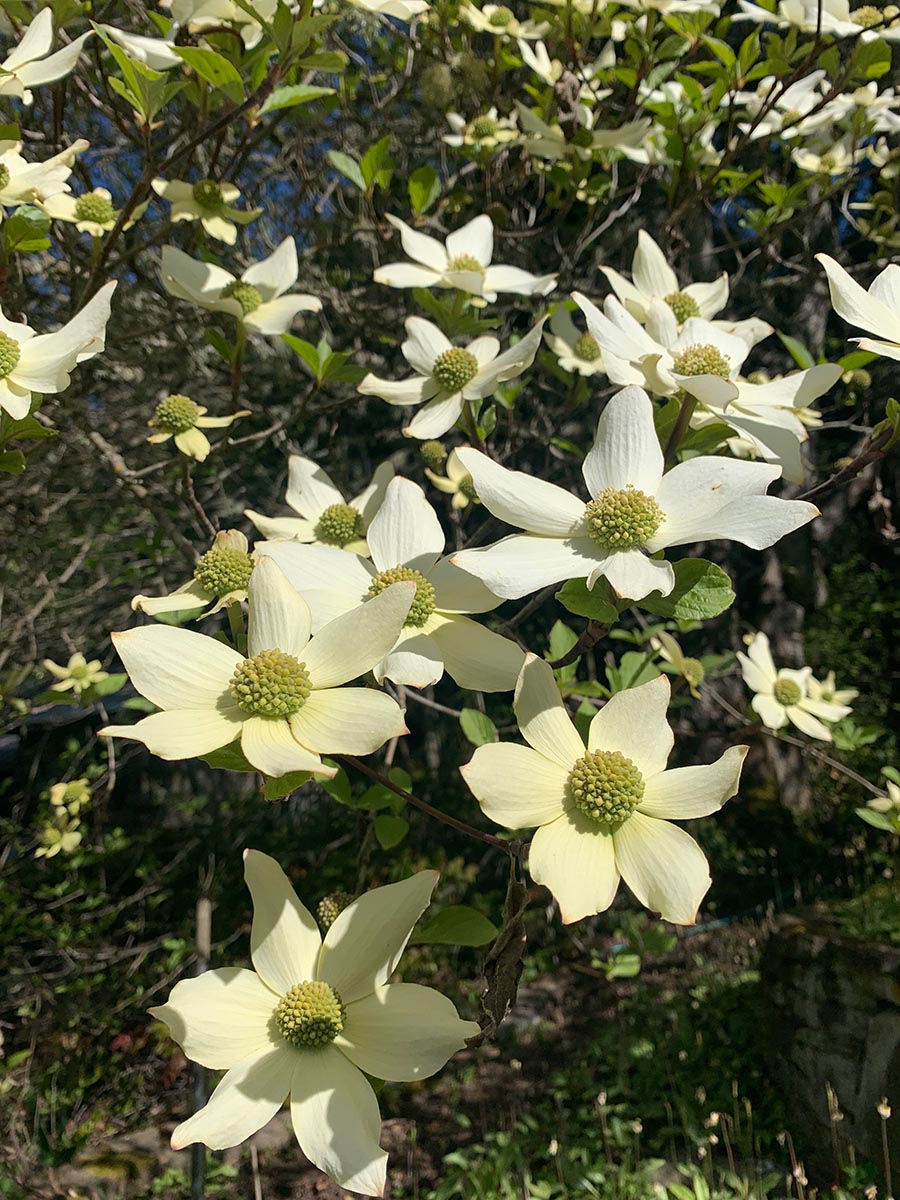
Flower: Greenish-white with purple tips, small and inconspicuous (about 5 mm across). Flowers are arranged in tight, hemispheric clusters surrounded by 4-6 white or pinkish, large , showy bracts (2-7 cm long); the inflorescence appears to be one large flower.
Fruits: Clusters of bright red ‘berries’, each berry about 1 cm long.
Bloom: April-May, and often again in summer or fall.
More Information
Maintenance & Pruning: Requires minimal pruning and has specific maintenance needs focused on preventing disease, particularly Dogwood Anthracnose.
Landscape Use: Often used as an ornamental, this dogwood is a native tree for all seasons. It has a glorious show of flowers in spring, fine yellow-to-reddish foliage in fall, and a superb tracery of symmetrically-branched naked twigs in winter. Even in summer, it provides valuable shade and an occasional second bloom.
Pacific flowering dogwood has a high flood resistance, making it effective for streambank stabilisation in areas with deep and well-drained soils. Planting 18-25 ft apart is considered standard spacing.
Propagation: It reaches sexual maturity at 6-10 years of age. Large seed crops are produced at two year intervals. Seed maturity and dispersal occur from September to October. Collect seeds in fall by shaking or stripping the branches, and sow them directly without removing them from the fruit. Alternatively, clean them for storage by macerating in water and allowing the pulp to float off. Let the seeds dry, then store them in sealed containers at 3-5 degrees C for 2-4 years. Scarify stored seeds in concentrated sulfuric acid for 4 hours, rinse, then stratify at 3 degrees C for 90 days, and sow in the fall. Cover seed beds with up to 1.3 cm of soil and mulch with sawdust over winter.
Pacific flowering dogwood re-sprouts from the root crown after disturbance by fire or logging. Take cuttings in June and July and treat with a rooting hormone. Cultivate in clay pots to help retain water and prevent root rot. Cuttings should be kept for no more than two years since transplants after this time have a high mortality rate. When transplanting, place Pacific dogwood in a ring of native shrubs to protect the lower trunk and branches from sunburn (Rose, Chachulski, Haase 1998).
Pests, Animals & Diseases: The fruit is a staple of black bears and many birds. Beavers eat the fruits, wood, and leaves, while deer browse the twigs and leaves.Dogwood Anthracnose is a foliar disease caused by the Discula destructiva fungus. Tan-coloured spots and necrotic blotches form on leaves. Infections often progress to shoots and stems.
Cultivars: ‘Eddie’s White Wonder’ A cross of C. florida × C. nuttallii was originated by nurseryman Henry M. Eddie of Vancouver, British Columbia. Commercially propagated since 1955, patented in 1964.
Comments: The provincial floral emblem of British Columbia. Named after Thomas Nuttall, a close friend of James Audubon. He was the first scientist to recognize it as a new species when he saw it at Fort Vancouver in 1834.
The wood is in demand for making thread spindles, piano keys, and for other purposes, but its collection is prohibited by law in B.C.
Leave a Reply