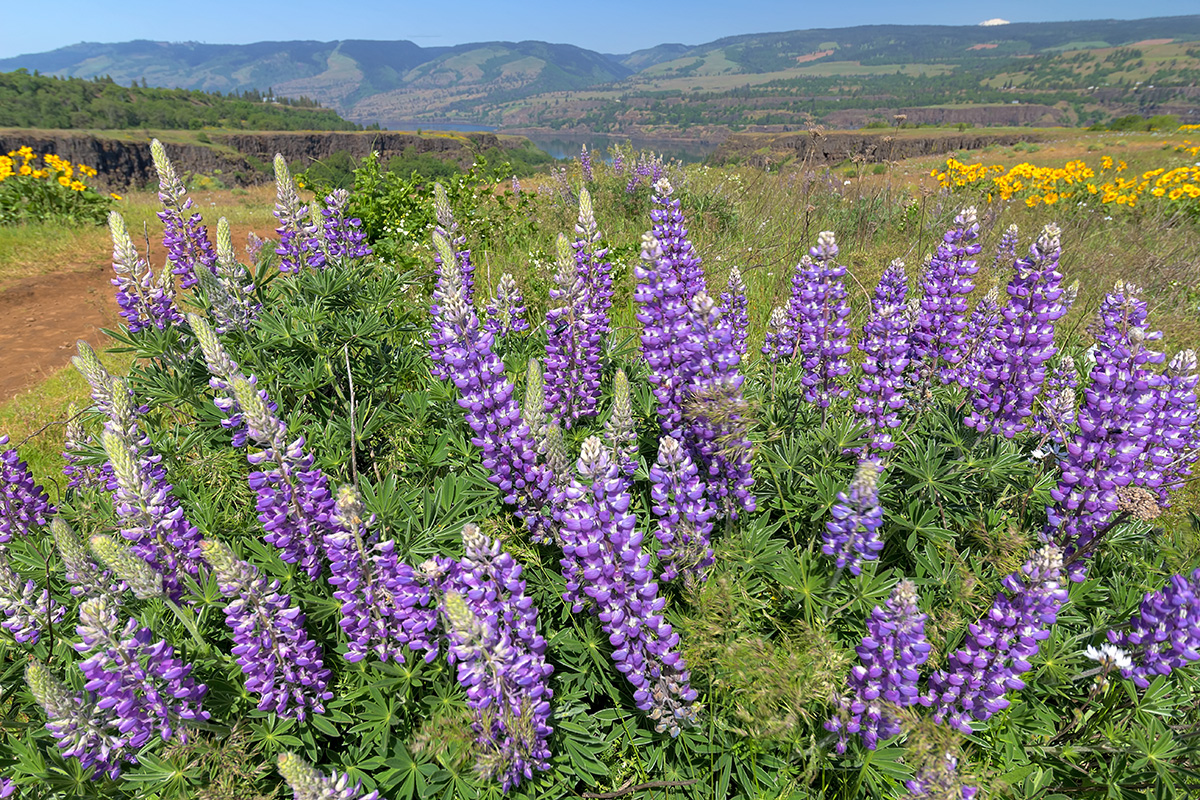
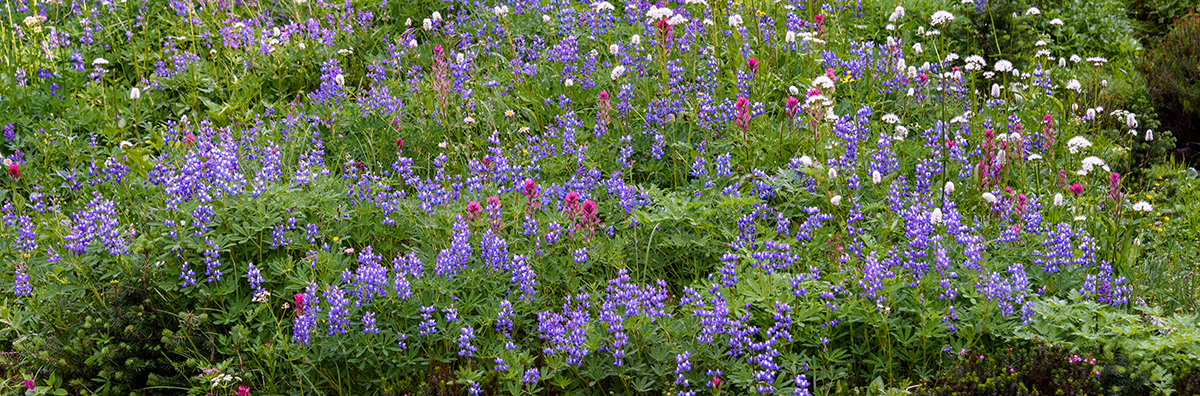
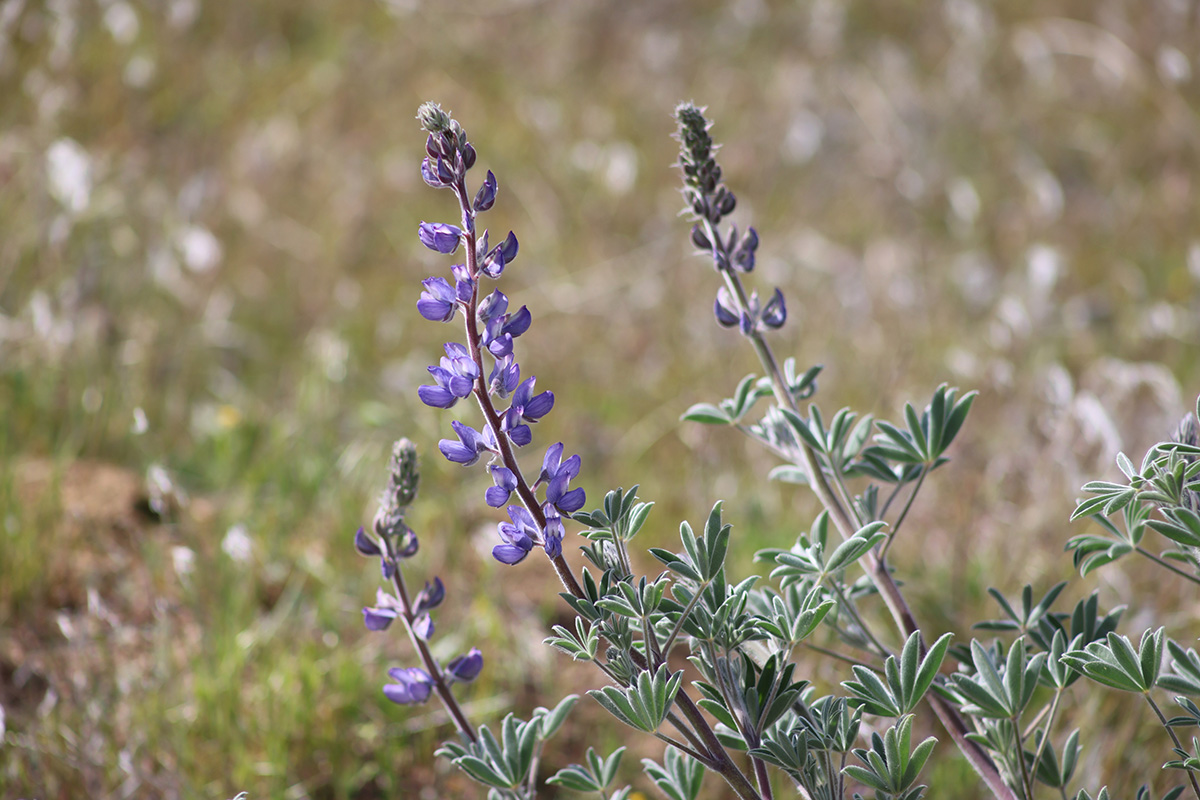
Broadleaf Lupine
Perennial Bushy Herbaceous
Common Names: Broadleaf lupine, Bigleaf lupine, Riverbank lupine, also known as Arctic Lupine (L. arcticus)
Species: Lupinus latifolius
Family: LEGUMINOSAE
Zone: 5-9
BEC Zones: Coastal Douglas fir and hemlock, alpine meadows
Height: 30-60 cm
Width: 60 cm-120 cm
Conditions
Sun: Full sun to part shade.
Soil: Moist, shallow, coarse-textured, rocky and fast-draining; sandy loam.
Moisture: Dry to mesic.
Exposure: Open areas at all elevations, but most commonly and abundantly at middle to sub-alpine elevations; woodlands and meadows.
Appearance
Shape & Stem: Several erect stems from a branched rhizome; stems to 60 cm tall, slender, hollow, with long hairs.
Leaf: Mostly arising from near the base with long stalks, palmately compound; 6-8 leaflets up to 5 cm long, most with sharp, pointed tips.
Flower: Bluish, pea-like, up to 2 cm long; several in an elongated cluster.
Fruits: Hairy pods up to 4 cm long.
Bloom: May – July.
More Information
Maintenance & Pruning: Gently rhizomatous, tap-rooted.
Landscape Use: Fixes nitrogen and forms colonies. Valuable for rehabilitating disturbed sites: thrives in dry, low-fertility soils, stabilizes soil with its deep root system.
Space plants 12-24 inches apart to allow for their natural spread.
Propagation: Spreads by seeds and roots; fresh seed needs no treatment, and can be sown directly in spring or fall. If starting seeds indoors, use peat or coir pots to minimize root disturbance during transplanting.
Pests, Animals & Diseases: No serious pest or disease issues.
A favourite host plant for a suite of lupine-feeding butterflies, including the Silvery Blue. Attractive to bees and other pollinators.
Cultivars: There are a large number of native lupines found in the Pacific North West.
Native perennials: Nootka Lupine (L. nootkatensis) grows up to 1 m tall with blue (sometimes tinged pink or white) flowers. Grizzly bears enjoy the roots and make large feeding excavations in north coastal estuarine marshes, where both lupines and bears thrive. Seashore Lupine (L. littoralis) is found on sandy beaches and dunes along the immediate coast. Large-leaved lupine (L. polyphyllus) is widely cultivated as a garden ornamental; many colours and shades of this hardy perennial have been developed.
Native annuals: The annual small-flowered lupine (L. polycarpus, also called L. micranthus) grows 10-45 cm tall in open, gravelly, and sandy sites. Another annual lupine found in similar sites and range as two-coloured lupine (L. bicolor). The simplest way to distinguish them is to examine the leaflets: those of small-flowed lupine are smooth above, and those of two-coloured lupine are hairy above.
Non-native: two species have been introduced from California to the southern part of our region; both have yellow flowers. Dense-flowered lupine (L. densiflorus, also called L. microcarpus) is an annual found around Victoria and coastal Puget Sound. Tree lupine (L. arboreus) is a perennial shrub, introduced intermittently from Victoria southwards, perhaps to stabilize dunes. Dwarf mountain lupine (L. lyallii, also called L. lepidus var lobbii) is a small (leaflets up to 1.5 cm long), silky-haired perennial that grows in clumps in alpine and subalpine meadows and scree slopes on the southern BC mainland (south of 53°N), south to California.
Leave a Reply