
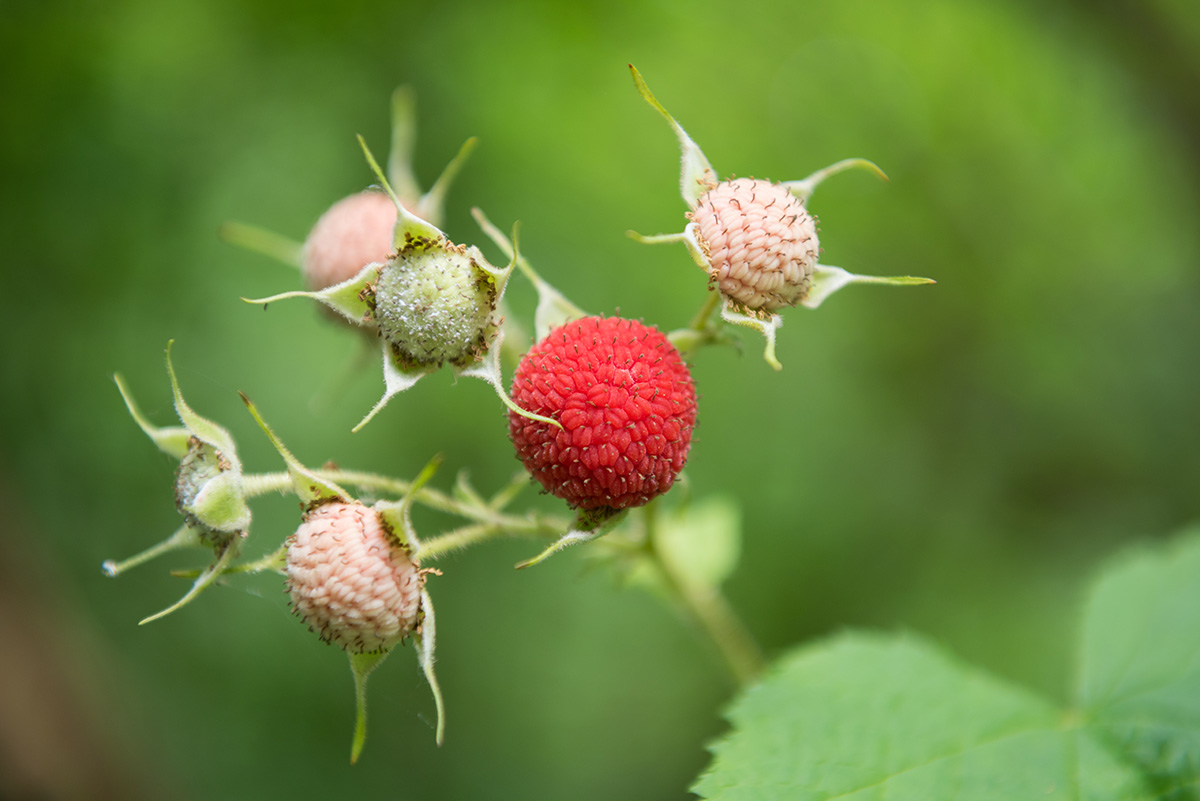


Thimbleberry
Broadleaf Upright Shrub
Common Names: Thimbleberry
Species: Rubus parviflorus
Family: Roseaceae
Genus: Rubus
Zone: 3-10
BEC Zones: BG, BWBS, CDF, CWH, ESSF, ICH, IDF, MH, MS, PP, SBPS, SBS
Height: 0.5 – 3 meters
Width: 1 – 2.5 meters
Conditions
Sun: Full sun to part shade.
Soil: Clay, loam, sand. Moist and well-drained, organically rich, slightly acidic. Prefers nitrogen-rich soil.
Moisture: Dry to moist. It grows best in moist areas, but tolerates drier sites.
Exposure: Open sites (e.g. clearings, road edges, shorelines, avalanche tracks) or open (especially red alder) forest; low elevations in the north, low to subalpine elevations in the south. Common in open-canopy forests and early-seral communities. Can tolerate brief seasonal flooding.
Appearance
Shape & Stem: Deciduous shrub, erect or scrambling. Thin, “unarmed” (no prickles) stems, which are greenish and hairy. Often forms mats with long, flexible rooting branches. Reddish brown bark.
Leaf: Alternate, deciduous, large (up to 25 cm across), soft, toothed, maple-leaf-shaped leaves with 3-7 lobes, and long glandular stalks; finely fuzzy on both sides.
Flower: White, fragrant, large (up to 4 cm across); petals crinkled like tissue paper; several flowers (3-11) in a long, stemmed terminal cluster.
Fruits: Shallowly domed, raspberry-like clusters of red, hairy drupelets; juicy, insipid to sweet depending on growing site and personal taste. Flowers and fruits are produced on two-year-old canes (previous season’s growth).
Bloom: May – June.
More Information
Maintenance & Pruning: Remove canes that have fruited immediately after the fruit is harvested; leave the non-fruiting canes to overwinter. Remove any non-fruiting canes that are crowded, spindly, or diseased. In late winter, remove any damaged canes and thin the remaining canes as needed, leaving only healthy, well-spaced canes.
Landscape Use: Perfect for informal hedges, bird and wildlife gardens, and erosion control on banks and slopes. Spacing 1 – 2.5 m. This plant grows from extensive rhizomes, and spreads vigorously, usually forming dense thickets.
Propagation: Propagate by dormant rhizome segments, stem cuttings, or seeds.
Pests, Animals & Diseases: Watch out for leaf spot, anthracnose, botrytis, powdery mildew, spur blight, root rots, cane borers, and crown bores. Aphids can be troublesome. The flowers are a good nectar source for pollinators such as hummingbirds, bees, butterflies, and other insects. The berries support birds, bears, and small mammals. Leaves and twigs are grazed by deer and elk, and the dense stems provide a shelter for small birds and mammals.
Cultivars: Thimbleberry is a wild plant and not typically grown commercially or through selective breeding to create specific cultivars. While there are a few forms or varieties within the species (like Rubus parviflorus var. parviflorus and Rubus parviflorus var. velutinus), these are natural variations and not distinct cultivars developed through selective breeding.
Comments: Wide native range, from Alaska to California and the mountains of New Mexico, to northern Mexico, and eastward through the Dakotas to the Great Lakes States. R. odoratus, Flowering Raspberry, which is native to eastern North America, is sometimes called Thimbleberry, although this common name is best reserved for R. parviflorus. Parviflorus = small flowered.
Leave a Reply